Before diving into maintenance recommendations on GDI engines, it’s important to understand what makes them different from other fuel injected engines. The changes in fuel delivery methods started in the pursuit of engine power and fuel efficiency. The development of fuel injection systems began around the 1930s for use in aircraft engines. Using mechanical fuel injection systems, engine manufacturers found that they could more precisely deliver fuel to the engine during all operating conditions, thus reducing fuel consumption and increasing power. By reducing fuel consumption, the aircraft developers were able to extend the range of the aircraft while reducing operating costs. By the 1950s, fuel injection systems began to make their way into the automotive market. Mercedes Benz was one of the earliest adopters of this technology in their 1954 300SL. It used a Bosch direction injection system on their 3.0L six-cylinder engine instead of a carburetor. The vehicle was a wild success not only based on performance but also due to its unique style. By 1954 standards, it had great power, accelerated quickly, and could reach 155 MPH all while looking like an elegant rocket ship.

It took longer for fuel injection to make its way into new vehicle models due to the cost and complexity of the fuel injection control systems. Much of the change was due to tightening vehicle emission standards and the development of computer systems with the computing power to control the fuel injection systems. The transition from carbureted vehicle engines to fully fuel injection engines happened in the span of ten years. In 1985, 56% of new vehicles were carbureted. By 1995, 100% of the newly manufactured vehicles were fuel injected.
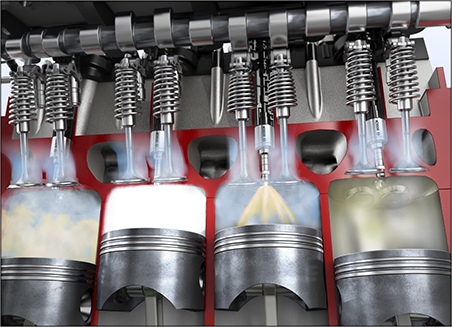
Not all fuel injection systems are the same though. There are many different types of fuel injection systems, each with their quirks. It all boils down to what part of the engine the fuel is sprayed into. Throttle Body Injection (TBI) systems spray the fuel into the center of the intake manifold, and the fuel droplets are carried into the cylinders with the incoming air. Multi-Port Fuel Injection (MPFI) systems take it one step further and have one fuel injector for each cylinder and spray the fuel charge directly at the back of the intake valve. Finally, there’s Gasoline Direct Injection (GDI) which sprays the fuel directly into each cylinder during the compression stroke under high pressure at the precise moment before combustion occurs.
As with any emerging technology, there are advantages and disadvantages to each design. The closer the injection spray gets to the combustion chamber, the more precise control there is over the fuel charge. Maximizing engine power and fuel efficiency. This is why many of the modern engines are moving towards the GDI design. Here is where we need to discuss the disadvantages of GDI engines. Carbon and oil sludge build up. Carbon and oil sludge is created from oxidized or broken-down oil, carbon deposits from incomplete fuel combustion, dirt, metallic particles, moisture, and other contaminants. For more information about oil sludge, see my article The Common Practice That Can Lead to the Early Death of Your Engine from February of 2026. Carbon deposits and oil sludge build-up have always been something that can accumulate inside an engine. When fuel is injected before the intake valve, like in the case of TBI and MPFI systems, the fuel has a cleaning effect as it travels through the intake manifold. Keeping the intake valves free from carbon build-up. GDI engines are designed to inject the fuel directly into the cylinder a.k.a. combustion chamber. Without the fuel washing over the back of the intake valve, it creates the perfect environment for carbon build-up. Which is a hardened version of oil sludge. Carbon build-up on the intake valves can lead to running problems and efficiency losses. When it builds up in the cylinder it can create hot spots leading to preignition. Many of the direct injection engines also use low tension piston rings in the constant pursuit of fuel efficiency. Low tension piston rings are prone to compression leakage and carbon build-up which can lead to excessive engine oil consumption. That excessive crankcase pressure can tax the PCV (Positive Crankcase Ventilation) system and leads to increased oil sludge build-up. See the full circle of problems here?
Here is when good preventive maintenance can keep your GDI engine running properly and efficiently. GDI engines require consistent oil changes and regular induction cleanings to stay ahead of the carbon build-up problem. Some manufacturers recommend performing a GDI Fuel Induction Cleaning Service every 15,000 miles to keep the engine operating at peak efficiency and prevent excessive carbon build-up. Should you find yourself with an engine that already has excessive carbon build-up or is starting to consume excessive oil quantities, fear not. Sanderson Auto Repair offers a specifically designed cleaning process call “The Sludge Buster Dynamic Engine Restoration” which in many cases can clean and dissolve the accumulated sludge and carbon build-up to give your engine a second chance at serving a long and useful life. Don’t wait until it’s too late, talk to our team about the recommended maintenance for your vehicle today!
Aaron Bjorklund